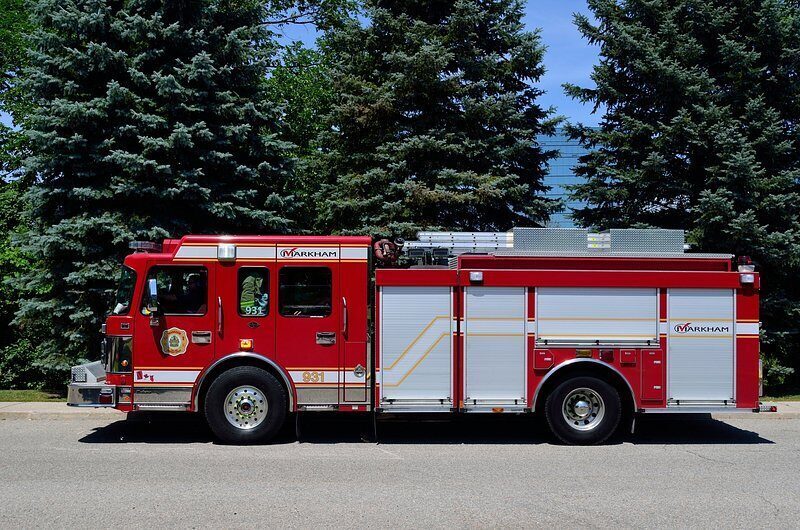
Modern emergency fleet graphics do far more than put a department name on a door. The right combination of fluorescent color, retroreflective sheeting and pattern geometry can make a parked apparatus readable from a quarter mile away at 2 a.m., while the wrong combination leaves a dark blue patrol unit nearly invisible on a rain-slicked shoulder.
For fleet managers and chiefs specifying new vehicles in 2026, the graphics package is a life-safety system, not a cosmetic line item. Ryan Taylor Graphics provides outstanding fleet graphics in Bucks County and across the local area.
Roadside Struck-By Incidents Are a Design Problem, Not Just a Driver Problem
Responders working traffic incidents are exposed to closing speeds of 55 to 70 mph while standing feet from live lanes. The Emergency Responder Safety Institute tracks dozens of struck-by fatalities among police, fire, EMS and towing personnel every year, and near-misses run into the thousands.
Passing drivers have roughly 2 to 4 seconds to detect, recognize and react to a scene at highway speed. Conspicuity research summarized by the U.S. Fire Administration in its emergency vehicle safety work found that contrast and pattern, not brightness alone, drive how quickly a driver identifies an emergency vehicle. That is exactly what a graphics package controls.
NFPA Chevron Rules and State Compliance
The chevron requirement most departments know as NFPA 1901 now lives inside NFPA 1900, the consolidated apparatus standard that absorbed 1901, 1902, 1906 and 1917 in its 2024 edition. The core visibility language carried over largely intact, and it is specific
- At least 50% of the rear-facing vertical surface must be covered in retroreflective chevron striping.
- Stripes run at a 45-degree angle in an inverted V pointing upward, in alternating colors of red and either fluorescent yellow-green or yellow.
- Each stripe must be a minimum of 6 inches wide.
- A retroreflective stripe must run at least 50% of the cab and body length on each side and 25% of the front, generally 4 inches or wider.
- Sheeting must meet ASTM D4956 minimum retroreflectivity, and most specs call for Type IV or higher rather than the entry-level Type I.
Compliance matters beyond the standard itself. Many states adopt NFPA language by reference into their fire service accreditation or grant conditions, and a non-conforming apparatus can jeopardize an Assistance to Firefighters Grant reimbursement or complicate an insurance claim after a rear-end collision. Fixing a chevron package after delivery typically runs $1,200 to $2,500 on a pumper, which is money that never needed to be spent.
Cast Vinyl Versus Retroreflective Film: What Changes Under Headlights
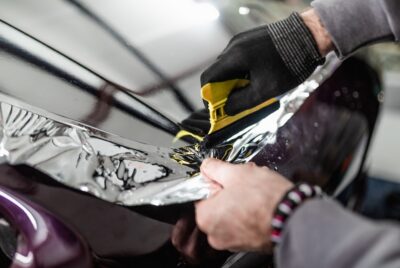
Standard cast vinyl is the right material for logos, unit numbers and color blocking. It holds color beautifully in daylight and conforms to rivets and compound curves. What it does not do is return light.
Retroreflective film uses either glass beads or microprismatic optics to bounce headlight energy straight back toward the driver’s eye.
The performance gap is not subtle:
- Engineer grade (Type I): roughly 70 candelas per lux per square meter for white. Adequate for a parking lot, weak on a highway shoulder.
- High-intensity prismatic (Type IV): in the range of 500 candelas, a practical baseline for chevrons and side striping.
- Diamond Grade DG3 and comparable Nikkalite prismatic films (Type XI): often 900 to 1,200 candelas, roughly ten to fifteen times engineer grade, with a wide entrance-angle response that still performs when a driver approaches at an angle.
Entrance angle is the detail most specs miss. A vehicle blocking a lane is rarely square to oncoming traffic, so a film that collapses in brightness past 30 degrees off-axis fails in the exact geometry where it matters most.
Fluorescent films handle the other half of the clock. Fluorescent yellow-green and fluorescent orange convert ultraviolet energy into visible light, which is why they look almost lit at dawn, dusk and in fog, the low-light periods when retroreflection has no headlights to work with.
Why Fleets Are Moving to Battenburg
The traditional single side stripe was designed for a slower era of traffic. Battenburg, developed by UK police research in the 1990s and now common on North American ambulances and patrol units, replaces it with a two-row checkerboard of high-contrast blocks, typically fluorescent yellow-green paired with blue, red or reflective silver.
The pattern works because human peripheral vision detects alternating high-contrast edges faster than a continuous band of color. Field studies behind the design found recognition distances improving substantially over plain markings, and drivers identified the vehicle as an emergency unit sooner rather than simply noticing something reflective ahead.
Practical considerations before you commit:
- Block size matters. Blocks that are too small blur into a single tone at distance, so most designs use squares roughly 12 to 24 inches depending on vehicle height.
- Half-Battenburg (a single row along the beltline) is a common compromise for agencies that want departmental identity retained above the pattern.
- Some jurisdictions restrict color combinations by vehicle class, so verify state motor vehicle code before finalizing artwork.
- A full Battenburg package on a patrol SUV typically lands between $2,500 and $5,000 installed; a complete ambulance package with NFPA-compliant rear chevrons often runs $3,000 to $7,000.
Durability and Real ROI Over an 8-Year Service Life
An apparatus stays in front-line service for a decade or more, and graphics have to survive everything that service throws at them. The failure points are predictable, which means they are preventable.
- UV overlaminate: a cast overlaminate with UV inhibitors protects printed colors from fading and adds abrasion resistance. Unlaminated digital print on a red pumper can shift noticeably within 24 to 36 months.
- Edge sealing: exposed vinyl edges are where diesel, foam concentrate and road salt get underneath. Sealed or wrapped edges around body seams and compartment doors add years.
- Pressure wash discipline: keep the wand at least 12 inches back, under about 1,200 psi, water below 140 degrees F, and never aim directly into an edge at 90 degrees.
- Chemical exposure: Class B foam, brake cleaner and citrus degreasers attack adhesive systems. Specify films rated for chemical resistance on lower body panels.
- Substrate prep: fresh paint needs 21 to 30 days of full cure before graphics go on, or outgassing creates bubbles that never fully release.
Done correctly, a premium package carries a manufacturer warranty of seven to ten years vertical exposure, and most fleets get the full life out of it. Amortized across a $650,000 apparatus, a $6,000 graphics package is under 1% of vehicle cost, and it is the only system on the truck that works while everything else is powered down.
A Short Spec Checklist for Procurement
- Call out ASTM D4956 sheeting type by number, not by brand name alone.
- Require NFPA 1900 rear chevron coverage and side striping percentages in writing.
- Specify fluorescent yellow-green for at least one chevron color.
- Require cast film with UV overlaminate for all printed elements.
- Ask for a proof rendered at scale, plus a nighttime retroreflectivity mockup.
- Confirm the installer’s warranty covers both material and labor.
Make Your Emergency Vehicle Stand Out
Ryan Taylor Graphics designs and installs NFPA-compliant reflective packages for fire, EMS and law enforcement fleets, including scaled proofs and nighttime mockups before anything gets printed. Send a photo of your current unit and we’ll put a materials spec and price in front of you. Contact us today!